


Amira, 29, was washing dishes on a Tuesday evening when her phone buzzed on the kitchen counter. It was her mother-in-law, Halima, a woman who had strong opinions about everything from how long rice should cook to how long a couple should wait before having children. The call lasted 47 minutes. Amira spent most of it nodding silently, saying "yes, Mama" at carefully timed intervals, her jaw tightening with each passing minute.
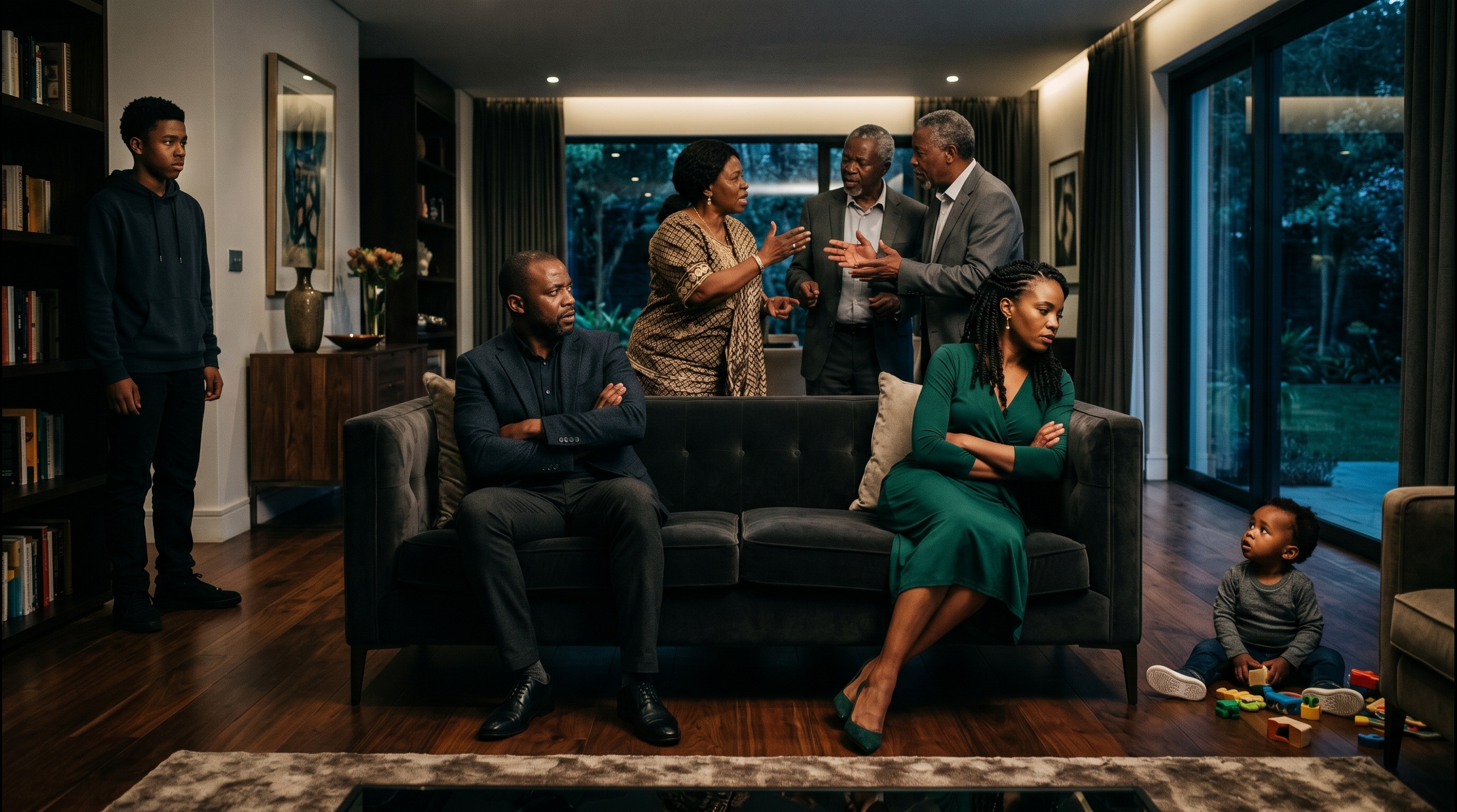
When her husband, Tariq, 32, walked into the kitchen 20 minutes later and asked who she'd been talking to, Amira simply said, "Your mother," and went back to washing the dishes. Tariq poured himself a glass of water, sensed the weight hanging in the air between them, and quietly left the room.
Neither of them spoke about it that night. Or the night after.
This is how it usually begins.
The gradual, almost gentle encroachment of extended family into the sacred, private world of a marriage.
It often feels harmless at first.
It often looks like love.
But left unchecked, family interference can quietly dismantle one.
Let's talk about it.
Let's Understand Why This Happens
Before we get to the signs, it's worth understanding the root of the problem because family interference rarely comes from a place of pure malice. Most of the time, it comes from love, fear, cultural obligation, and a deep-seated belief that family involvement is always a good thing.
In many communities, the extended family is not a background character in a marriage. It is, in many ways, the co-author. Elders are expected to guide. Mothers hold enormous influence. Brothers feel a sense of ownership over their sisters' choices. Aunts and uncles consider it their duty to weigh in. Community and family are among the greatest gifts a person can have.
This is not inherently wrong.
The problem arises when the line between support and control gets blurred.
When "I'm here for you" slowly becomes "I get to decide for you." When family involvement shifts from being a resource to being a referendum on every decision a couple makes.
That shift is where the danger lives — recognise it early.
Here Are the 22 Signs You Need to Watch For
1. Major decisions are never made without family consultation first
A couple should always be the primary decision-making unit in their own home. Extended family input can be welcome, but it should never be the prerequisite for a couple's autonomy.
2. Your spouse shares intimate details of your relationship with family members
What is shared in the privacy of a marriage should stay there. When a partner consistently takes private conversations to family members, it destroys trust, creates outside narratives, and makes the other partner feel unsafe being vulnerable.
3. You find out about important family decisions through other relatives rather than your spouse
When a spouse consistently excludes their partner from family-related information, it signals that the extended family holds a higher position in the hierarchy of importance than the marriage itself.
4. Extended family members feel free to visit without notice or invitation
A couple's home is their sanctuary. Boundaries around the physical space of a home are not rude, they are necessary. Uninvited access to a couple's space is a clear sign that the family does not respect the marriage as a separate entity.
5. Family members give unsolicited parenting advice that undermines your authority
Parenting decisions belong to the two people raising the child. Unsolicited advice that bypasses one parent and goes directly to the other is not just overstepping but actively undermines parental unity.
6. You or your partner uses family members as emotional support instead of each other
Emotional intimacy is the cornerstone of a healthy marriage. When a partner consistently turns to extended family for emotional support that should be shared with their spouse, the marriage becomes emotionally hollow over time.
7. Financial decisions are influenced or controlled by extended family
Financial decisions in a marriage must be made by the couple together. When extended family influence overrides a partner's voice on financial matters, it creates resentment and economic instability.
8. Your spouse defends family behaviour that clearly harms you
A spouse who consistently defends family behaviour at the expense of their partner's emotional wellbeing is not keeping the peace but choosing a side. And that side is not their marriage.
9. You feel like a guest in your own relationship
Every partner in a marriage deserves to feel like a co-author of their shared life, and not a visitor who has to earn her place at the table.
10. Arguments about the family are becoming more frequent than arguments about anything else
When family interference becomes the recurring theme of marital conflict, it is not a communication problem. It is a boundary problem. And boundaries are what need to be addressed.
11. Extended family members speak negatively about your partner to others
A family member who speaks negatively about your partner to others is not just gossiping, they are creating a social environment that is hostile to your marriage.
12. Your partner changes personality around family members
When a partner consistently reverts to a childhood role in the family system, it signals that the family dynamic still holds more power than the marriage.
13. You're expected to participate in family traditions even when it affects your health or wellbeing
No family tradition is worth a partner's physical or mental health. A spouse who cannot advocate for their partner's wellbeing in the face of family expectations is placing obligation above love.
14. You feel monitored or reported on within the family circle
Surveillance within a family system creates a climate of fear and inauthenticity. No one can be fully themselves, or fully present in their marriage, when they feel constantly watched.
15. Your mental health is being affected by family dynamics
When extended family interference begins to affect your sleep, your appetite, your ability to enjoy daily life, it has crossed from inconvenient into dangerous. This is a mental health matter, and it deserves to be treated as one.
16. Your spouse does not create a united front with you in family situations
A marriage is, above everything else, a partnership. The non-negotiable foundation of that partnership is that each person knows, without question, that their spouse has their back. When that certainty is absent, everything else begins to shake.
17. Important milestones are hijacked or dominated by family members
A couple's milestones belong to them. When family members consistently take over these moments, they send a message that the couple's autonomy over their own life narrative does not exist.
18. You feel you cannot speak freely about family issues with your spouse
When a partner cannot raise concerns about family dynamics without fear of backlash, the marriage loses one of its most essential functions: being a safe space.
19. You're being compared to other family members or previous partners
Comparison is a subtle but corrosive form of manipulation. No partner should ever be made to feel that they are in competition for their place in their own marriage.
20. Family interference affects your physical intimacy and connection
Emotional distance, caused by family interference, has physical consequences. A couple that cannot fully connect emotionally will eventually struggle to connect in any other meaningful way.
21. Extended family members give your children information or beliefs that contradict your parenting choices
When extended family members undermine parental authority with children, they are eroding the structure and security of the family unit. Children should never be made into tools of family conflict.
22. You have started to wonder whether the marriage is worth continuing
When a partner reaches the point of questioning the fundamental value of their marriage due to family interference, the situation has moved past uncomfortable into genuinely dangerous. This is the final warning sign, and it deserves an immediate, honest, courageous response.
So What Do You Actually Do?
Set boundaries as a united front. Boundaries are about protection. Decide together, as a couple, what the rules are around family access, communication, and involvement in your decisions. Then uphold them together.
Stop outsourcing your emotional processing. Your spouse should be your primary emotional confidant. Not your mother, not your sister, not your best friend from university. Build the habit of turning inward, to each other, first.
Have the hard conversations before they become emergencies. The time to address family interference is when you first notice the pattern forming. A small, early conversation is infinitely easier than a crisis negotiation.
Seek professional support without shame. There is no weakness in getting help — there is only wisdom.
Protect your home as a sacred space. Your home, your schedule, your children's routines belong to your family unit. Protect them accordingly. Kindly, firmly, without apology.
:max_bytes(150000):strip_icc()/GettyImages-667816610-5988bfc422fa3a00109ffb28.jpg)