

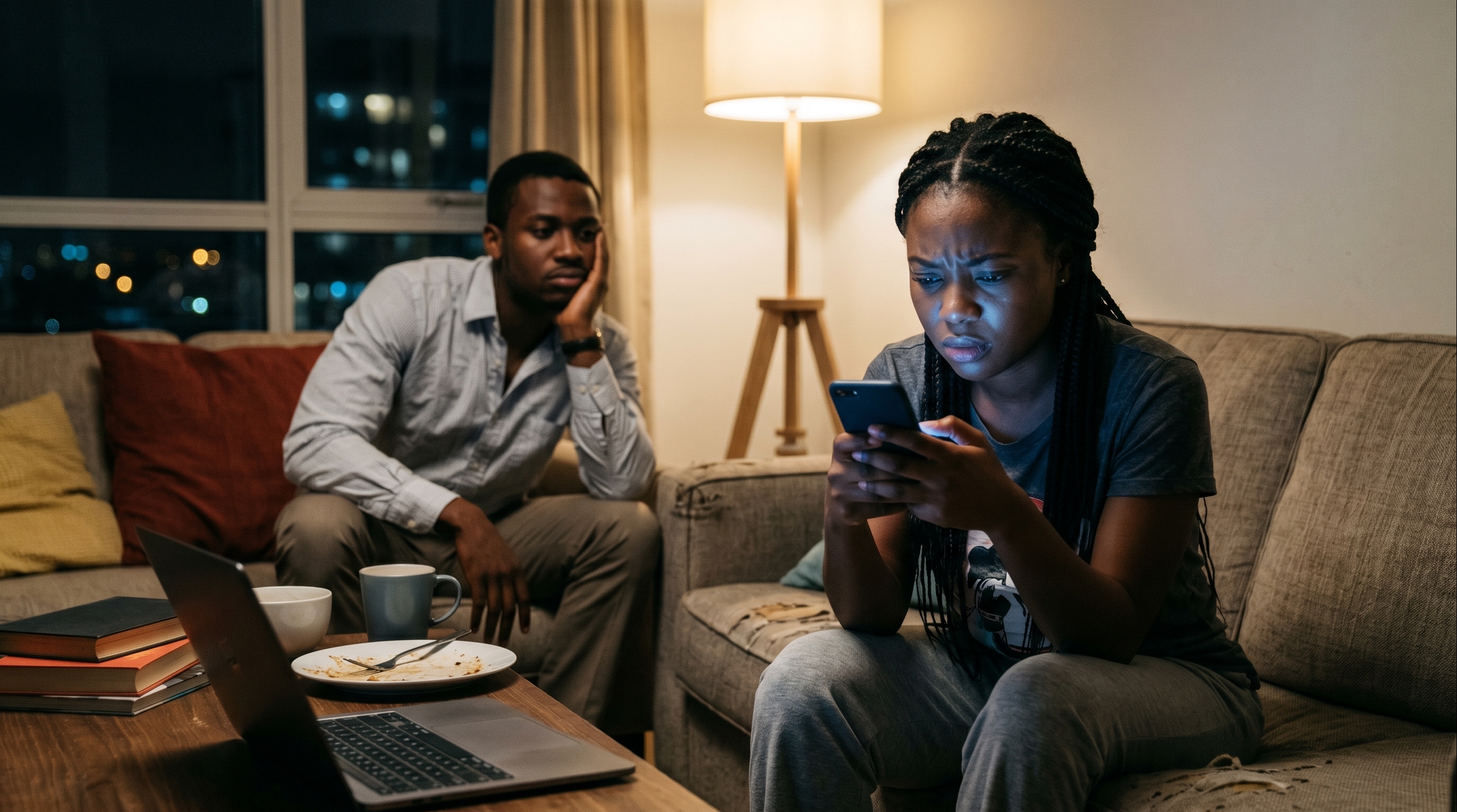
Achieng had always been the kind of person who said what she felt, when she felt it, and trusted that honesty delivered quickly was always better than honesty delivered slowly. So when she and her husband, Otieno, had settled into married life in their quiet apartment in Kileleshwa, Nairobi, it felt completely natural to her that they continue their good morning messages, voice notes during lunch breaks, memes forwarded in the middle of meetings, and check-ins at three in the afternoon just to say "thinking of you,".

But somewhere around their 18 month of marriage, she noticed her husband had started responding later, shorter, with the kind of brevity that felt less like a man at peace and more like dutifully, but without joy.
Otieno sat across from her at their small dining table, both hands wrapped around his mug, and said, "Achieng, I love talking to you, but sometimes I feel like by the time I get home, we've already had all our conversations, and there's nothing left to say in the same room."
The words landed more like a key turning in a lock she hadn't known was there, opening a door onto something she needed to see. She realised, sitting there that what she had understood as connection had slowly become constant, well-intentioned, loving noise that had been quietly crowding out the very intimacy she was trying to protect.
1 - The Illusion of Constant Contact
There is a deeply human instinct behind over-texting, and it deserves to be named with compassion rather than criticism. It usually comes from love, from anxiety, or from both at the same time.
When you love someone, you want to be near them, and when they're not physically present, the phone becomes the way of reaching across distance and saying, "I'm still here, and so are you."
The problem is that constant digital contact creates an illusion of intimacy without delivering the substance of it, because real intimacy is built in the quality of attention given. When your partner's phone buzzes seventeen times before noon with messages from you, what you may intend as warmth can land as pressure, and that distinction, though subtle, changes everything about how the relationship breathes.
2 -What Over-Texting Actually Does to Your Partner's Nervous System
When someone receives a high volume of messages throughout the day, their nervous system begins to associate the phone with a low-grade sense of obligation and vigilance. It becomes a source of mild stress rather than pleasure, even when the messages themselves are loving.
Over time, this association builds, and what was once a thrill becomes something that produces a flicker of tension instead.
3 - The Specific Ways Over-Texting Erodes Real Conversation
One of the most honest things you should reckon with iss this: by texting everything throughout the day, you was inadvertently consuming the raw material of your evening conversations before those conversations could happen organically.
The funny thing that happened at the supermarket, the frustration about a colleague, the small observation about the way the light looked at dusk — all of it is being filed into a text thread instead of being saved for the kind of face-to-face conversation where tone, eye contact, and shared laughter make an anecdote genuinely connective.
Real conversation between partners is one of the most powerful bonding mechanisms available to a couple, and when it's pre-empted by a digital transcript of the day, something irreplaceable is quietly lost.
4 - Texting Cannot Carry the Emotional Load You're Placing on It
Text messages are a limited communication medium, and we are asking them to carry far more than they were designed to hold. Nuance gets lost in text: the warmth in someone's voice, the softness in their expression, the body language that tells you someone is engaged and present rather than distracted and typing on autopilot.
When couples rely heavily on texting as their primary emotional communication channel, misunderstandings multiply, because the gap between what was written and what was felt can be wide enough to plant seeds of unnecessary hurt.
5 - The Attachment Anxiety Behind the Screen
Over-texting is less about communication and more about reassurance. This is not a character flaw; it is an attachment pattern, and it's more common than most people admit.
But it's important to understand that using text messages as an anxiety management tool places an invisible burden on your partner, who is now responsible for your reassurance every few hours through the medium of a smartphone screen.
That responsibility can quietly shift the relational dynamic in ways that create distance rather than closeness.
6 - What Silence Between Couples Actually Means
Our culture has developed an uneasy relationship with silence, treating it as a sign of disconnection rather than a natural feature of two people who are living their individual lives while building a shared one.
But comfortable silence is actually one of the markers of a secure, mature relationship.
7 - How to Communicate Better Without Communicating Constantly
The most important reframe here is investing the energy that was going into constant digital contact back into the quality of your in-person time together.
It means saving some of your best observations, your funniest moments, and your more emotionally loaded feelings for conversations that happen face to face, where you can see each other, respond to each other's full humanity, and build the kind of shared experience that a text thread, however loving, simply cannot replicate.
8 - The Deeper Gift of Intentional Communication
Intentional communication is one of the most loving things you can practice in a relationship, because it signals to your partner that you respect their attention, their energy, and the quality of your shared time.
For couples navigating the beautiful and complicated business of building a life together in their twenties and thirties, in cities where work pressure, financial stress, and social demands are all real, the quality of how you communicate matters enormously.
There is a kind of love that doesn't need to announce itself every hour to remain real, and learning to trust that kind of love is one of the quiet disciplines of a healthy relationship.
If you are a person who over-texts, the invitation here isn't to be less loving, less attentive, or less communicative.
It is simply to redirect some of that love from the small screen to the shared physical space of yours, to trust that the connection is real enough to survive a few hours of silence, and to discover what your relationship sounds like when it's allowed to breathe.



Comments (0)
Please sign in to join the conversation.
Loading comments...