

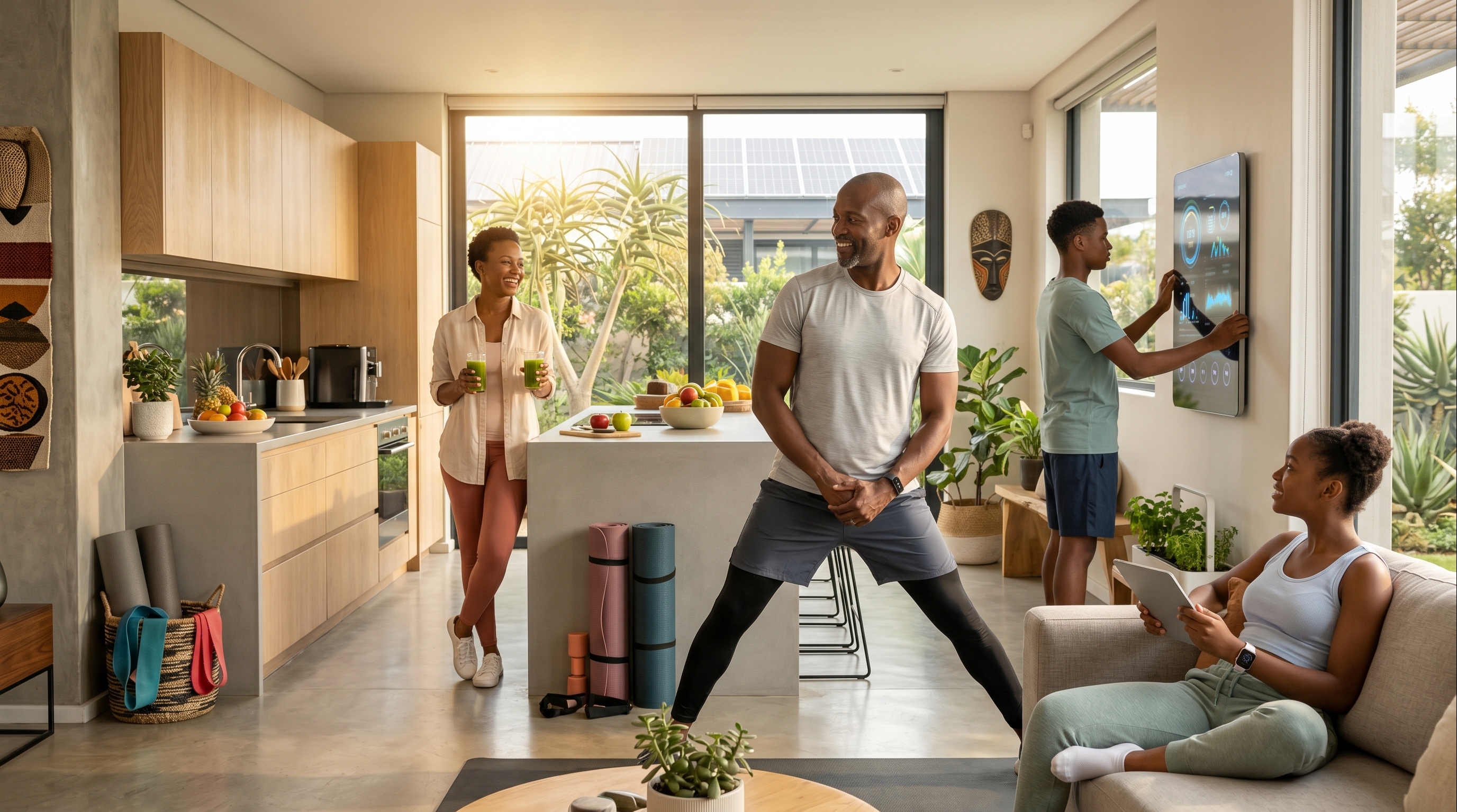
Lindiwe walked in already dressed for school and asked her father, Sipho, a question that stopped him cold, "Daddy, why do you look tired even when you just woke up?" He laughed it off, told her he'd had a long week, and sent her off to brush her teeth, but the question sat with him the entire day, through three client calls he barely remembered taking and a drive home where he couldn't recall a single landmark he'd passed.

Sipho sat on the edge of the couch and admitted something to himself that he hadn't said out loud in years: he didn't actually know what taking care of himself looked like anymore.
He knew how to provide.
He knew how to fix the leaking tap, help with homework, drive his mother to her clinic appointments, and show up to every parent meeting with a smile that hid whatever he was carrying.
But somewhere between becoming a husband and becoming a father, he had stopped being a person with needs of his own.
This is where so many fathers find themselves, and it's exactly why the idea of a wellness stack matters more in 2026 than it ever has before.
It's less about escaping fatherhood and more about staying whole inside it. Fathers don't fall apart because they're weak, they fall apart because nobody ever handed them a manual for how to hold a household together while also holding themselves together, and most of them were never shown what that even looks like growing up.
Why So Many Fathers Quietly Run on Empty
Many men grew up watching their own fathers provide without ever pausing, so silence became confused with strength.
Sipho's own father, a mineworker from Mpumalanga, came home every evening, ate his dinner, and sat in front of the radio without saying much. As a boy, Sipho thought that was simply what fathers did.
Nobody told him that his father might have been exhausted, anxious about retrenchments, or grieving friends lost underground. Nobody told him those feelings had to go somewhere. So when Sipho became a father himself, he carried that same silence forward without realizing it was a borrowed habit rather than a personal truth.
This matters because the wellness stack a father builds for himself isn't just about him, it quietly becomes the blueprint his children absorb about what manhood and fatherhood are supposed to feel like, and that's a responsibility worth taking seriously rather than ignoring.
There's also the practical weight that nobody warns young fathers about until they're already drowning in it: school fees that rise every January, transport costs, a sick parent who needs care, a job market that doesn't guarantee security even to those who work hardest.
Add to that the emotional labour of being the one who has to stay calm when a child is struggling at school, when a marriage hits a rough patch, and it becomes obvious why so many fathers describe themselves as "fine" while privately feeling like they're running on fumes.
Feeling overwhelmed does not make you a failing father, it makes you an honest one, and honesty is the first ingredient of any wellness stack worth building.
The First Layer: A Morning Anchor That Belongs Only to You
Sipho's turning point came three weeks after that kitchen conversation, when his colleague Bongani, a father of two from Mamelodi, mentioned almost casually over lunch that he'd started waking up 20 minutes earlier than his household just to sit outside with his coffee before anyone needed anything from him.
Bongani wasn't doing yoga or meditating in some elaborate way; he was simply present with himself before the day demanded he be present for everyone else.
Sipho tried it the following Monday, sitting on his small back step with his rooibos, and something in him exhaled for what felt like the first time in months.
This is the first layer of the stack, and it's deceptively simple: claim a small window of time, even fifteen minutes, that is yours before the household wakes. It doesn't need a ritual or a candle or an app. It needs consistency, and it needs to be protected.
The Second Layer: Naming What You Feel, Out Loud, To Someone
Weeks later, Sipho found himself at his cousin Thabo's place for a weekend braai, and somewhere between turning the meat and pouring drinks, Thabo asked him directly, "Bra, how are you really doing, not the WhatsApp status version?"
Sipho almost gave the automatic answer, the one that says "I'm coping," but something in Thabo's steady eye contact told him this was a safe place to be honest. He talked about the pressure of the school fees, the guilt of missing Lindiwe's netball match because of work, the quiet fear that he was becoming his own father in ways he didn't want to repeat.
Thabo nodded, and said, "That sounds heavy, ngane yam, and you're allowed to say that."
Sipho drove home that night lighter than he'd felt in months, not because his problems had disappeared, but because he'd finally said them out loud to another man who didn't flinch.
This is the second non-negotiable layer of the wellness stack: at least one relationship, whether a friend, a brother, a cousin, or a counsellor, where a father can speak honestly without performing strength.
Bottling emotions doesn't make a man more reliable, it makes him a ticking clock, and the people who love him eventually feel the fallout of an explosion that could have been a conversation.
As a father reading this and you cannot immediately name one person you could call tonight and be fully honest with, that is the gap to close first, before anything else on this list, because everything else works better once that outlet exists.
The Third Layer: Movement That Asks Nothing of You Except Presence
Naledi noticed the shift in Sipho before he did. She mentioned one evening that he seemed less snappy, more patient with Lindiwe's questions, and asked what had changed.
He realized it wasn't just the morning coffee or the conversation with Thabo, it was also the Saturday walks he'd started taking around the local park, sometimes alone, sometimes with Lindiwe riding her bicycle beside him. He wasn't training for anything. He wasn't chasing a fitness goal or a six-pack he'd seen on social media. He was simply moving his body in a way that gave his mind room to breathe.
Movement doesn't need a gym membership or a structured programme to count as wellness; a walk around the block, a kick-about with the kids in the yard, or stretching for ten minutes before bed all qualify, because the goal isn't performance, it's regulation.
A body that moves regularly produces a mind that copes better, and that's not a Western health magazine claim, it's something fathers across every community have quietly known for generations, even if they never called it wellness.
The Fourth Layer: Goals That Belong to the Father, Not Just the Family
Here is something every father must sit with directly: somewhere along the way, many men stop having personal goals and only have family goals, and while providing for a family is noble, a man who has nothing he's working toward for himself eventually feels like a shadow in his own life.
Sipho had once dreamed of finishing a diploma in supply chain management, a dream he'd shelved indefinitely when Lindiwe was born. After his conversation with Thabo, he quietly enrolled in an evening course, two nights a week, nothing dramatic, just one small step toward a version of himself he hadn't abandoned, only postponed. His wife didn't see this as selfish; she saw it as the most attractive thing he'd done in years, because a father chasing his own growth models something powerful for his children: that becoming a parent doesn't mean disappearing as a person.
As a father, name one goal, however small, that belongs only to you, write it down somewhere visible, and take one step toward it this month, because it reminds you that you are still becoming someone.
A Word Directly to You, Father to Reader
If you've read this far and recognized pieces of Sipho in you, we want you to know that none of this requires a complete overhaul of your life starting tomorrow.
Build this stack one layer at a time, in the order that feels most urgent to you. Start with the layer that's screaming the loudest in your life right now, whether that's finding someone to talk to, claiming 15 quiet minutes, moving your body, chasing a personal goal, or simply allowing yourself to rest without apology.
And if you are not the father in this story but someone who loves one, a partner, a sibling, a friend, a child now grown, consider this your invitation to check in on the men in your life the way Thabo checked in on Sipho, because so many fathers are quietly waiting for someone to ask the real question instead of accepting the rehearsed answer.

Comments (0)
Please sign in to join the conversation.
Loading comments...