

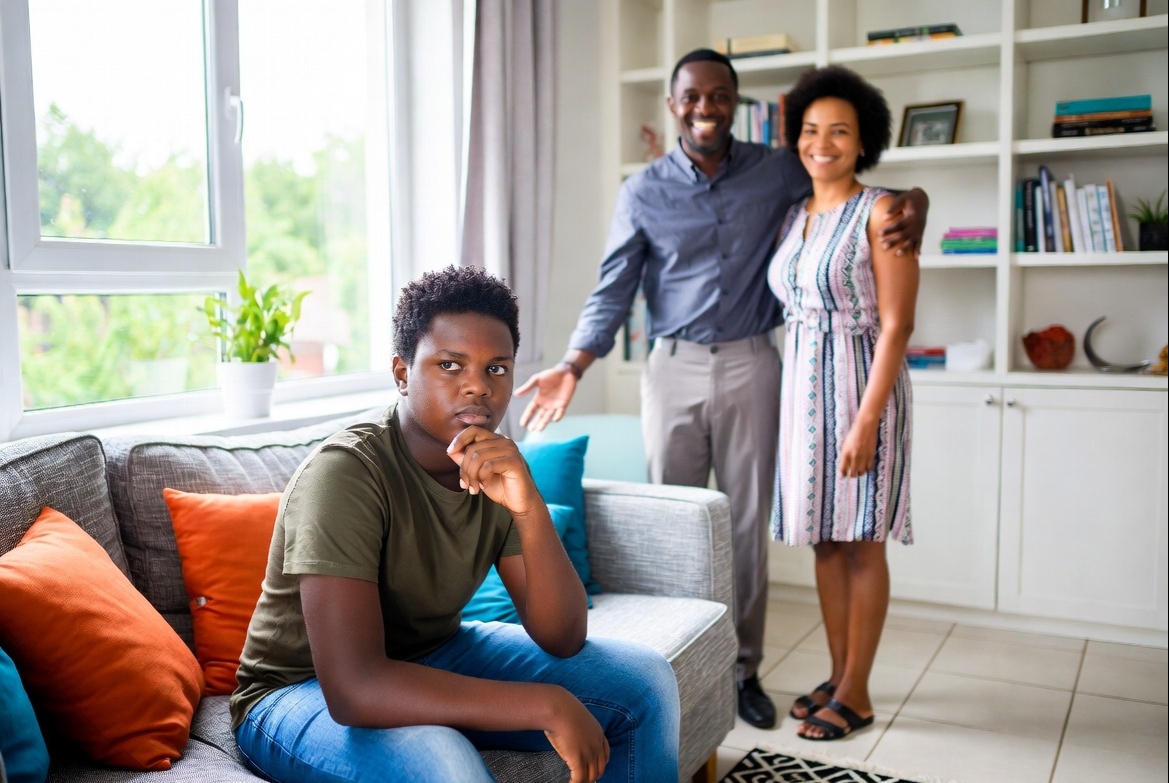
There is a particular moment, quiet and almost unnoticed, when a father stops being simply "Dad" and becomes something with a prefix. Nobody announces it. Nobody marks it on the calendar. But the day a stepmother enters the picture, the whole shape of a family shifts, and right in the middle of that shift stands a man who is now, technically, a stepfather too.

It sounds strange when you say it out loud, doesn't it? We talk endlessly about the stepmother, her role, her challenge, her complicated place in family folklore. But the father? He tends to get forgotten. He is the bridge between his old life and the new one. He is standing in the middle of two worlds, trying to hold both together without dropping either.
The Quiet Identity Shift
Here is the truth that most people skip over. When a stepmother comes in, the father does not just gain a partner. He gains a whole new identity. He becomes a stepfather, not to his own children, but in the sense that his family is now blended, layered, and a little more complicated than it used to be. He has to figure out how to parent his children alongside someone who is not their biological mother. That is not a small thing. That takes real emotional work.
The One Simple Shift That Can Transform Your Family Overnight
Many fathers in this situation describe a feeling of being caught. They love their children fiercely and want to protect them. They also love their new partner and want to build something meaningful with her. What nobody tells you is how often those two things pull in opposite directions, not because of any real conflict, but simply because rebuilding a family is genuinely hard.
The Children Are Watching
Children are remarkable observers. They notice everything. How Dad looks at the new woman, how he talks to her, whether he laughs differently, and whether he seems nervous. They are not trying to cause trouble; they are simply trying to work out where they stand. A huge part of that is watching their father work out where he stands too.
When a father handles this transition with honesty and warmth, when he makes it clear that his love for his children has not changed, that the arrival of someone new does not mean anyone is being replaced, children tend to do better. Research consistently supports this. Stability, communication, and reassurance matter far more than having the "perfect" family structure.
However, this puts enormous pressure on the father. He has to be the emotional anchor for his children while also navigating his own feelings about the new situation. He has to make space for a new partner while holding firm to the routines and values his children rely on. He has to be patient with a process that has no clear timeline and no instruction manual.
What Actually Helps
The fathers who seem to navigate this best are the ones who stop trying to make everything feel "normal" and instead allow the family to find its own rhythm. They talk to their children, not just once, but regularly. They check in and ask questions rather than force their new partner and children to bond overnight, because real relationships take time and cannot be rushed.
They also look after themselves, which is something fathers rarely give themselves permission to do. Processing a major life change takes energy, and a man who is running on empty cannot be fully present for his children or his partner. Talking to a friend, a therapist, or even just finding a quiet hour to think matters.
The Stepmother's Side of The Equation
It would be unfair not to mention what the stepmother is carrying, too. She is walking into a family that already has a history, already has inside jokes and holiday traditions and tender spots she has not yet learned about. She is trying to build genuine relationships with children who did not choose her. She may feel like an outsider in her own home some days, and that deserves acknowledgement.
The father's role here is crucial. He cannot leave her to find her footing alone, and he cannot abandon his children to navigate their feelings alone either. He is the common thread. He has to communicate with her about the children, with the children about her, while performing with a level of honesty that is not always comfortable.
Blended families work best when the adults work together: not as a performance of togetherness, but as a genuine, sometimes messy, always evolving partnership.
A Family By A Different Name
In the end, the prefix does not diminish the father. "Stepfather" is not a lesser version of "father." It is simply a different chapter of the same story, one that asks more of a man, and perhaps, if he rises to it, reveals more of who he truly is. The love does not change. The children are still his. The home is still theirs. It just looks a little different now, and that is all right.
Different is not broken. Different is just where some of the most meaningful families begin.

Comments (0)
Please sign in to join the conversation.
Loading comments...