

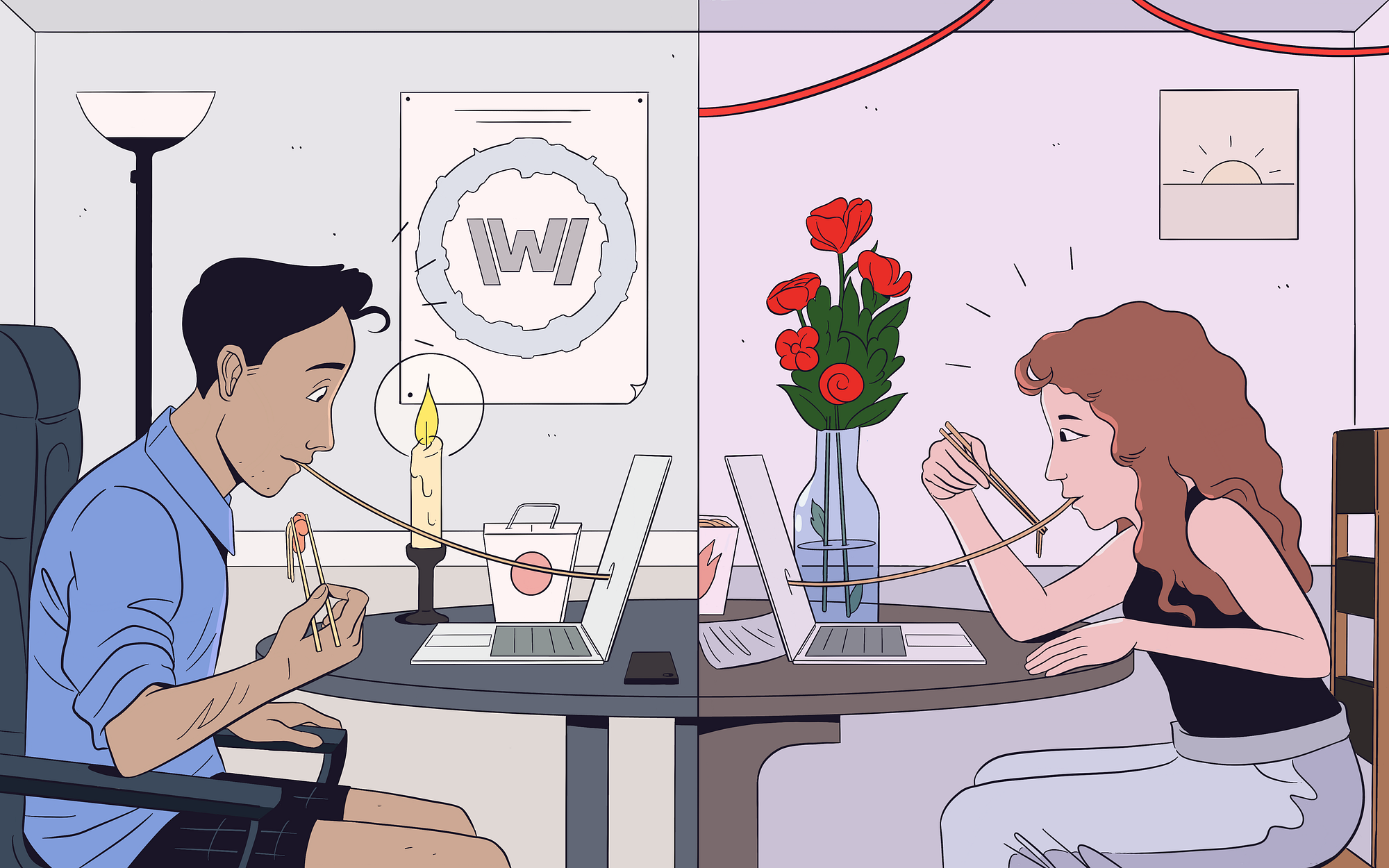
It was a Friday evening, the kind where the city hums and glitters just enough to make staying indoors feel like a small rebellion. Yasmine and her best friend Lina were sitting cross-legged on Yasmine's apartment floor, surrounded by the remnants of a takeaway dinner. The balcony door was slightly open, and the sound of the street drifted in softly, like background music to a conversation that was just starting to get real.

They had been talking for nearly two hours, moving through the usual topics when Lina put her phone face down on the carpet and looked at Yasmine with the particular expression that meant she was about to say something true.
"Do you ever feel," Lina said slowly, choosing her words the way you choose footing on uneven ground, "like you know how to talk to people online, but you've forgotten how to actually be with them in real life?"
This is for the singles who feel it too. The ones who are excellent at curating themselves online and a little lost when it comes to being truly seen offline.
Yasmine and Lina are not struggling people. They are educated, warm, thoughtful, and deeply connected to their families and their faith. But they are also part of a generation that grew up with one hand in the real world and one hand in a digital one, and somewhere in the middle of that balancing act, something about how they understand intimacy has quietly shifted. And they are only now beginning to name it.
To understand what has happened to intimacy, you have to understand the world that raised this generation of young people.
Yasmine got her first smartphone at fourteen. By the time she was eighteen, she had spent thousands of hours consuming content on relationships modelled in short videos, love performed in comment sections, connection measured in likes and follower counts. Not because she was frivolous or naive, but because that was simply the water she swam in. That was the air. And air shapes you, even when you're not paying attention to it.
The digital world did not set out to damage anyone's capacity for intimacy. But it built an environment that rewards performance over presence, image over authenticity, and the quick dopamine hit of a notification over the slow, patient work of actually knowing and being known by another person. And when that environment becomes the primary place where young people learn what connection looks and feels like, it starts to rewrite the internal blueprint of what intimacy is for and how it works.
10 Ways Digital Culture Has Quietly Rewritten the Script on Intimacy
1. It has taught young people to lead with the curated self, not the real one. Lina once spent forty-five minutes choosing which photo to post from a trip she had genuinely enjoyed. The irony is rich and painful: the experience was real, but presenting it required so much construction that the real self got buried somewhere underneath the aesthetic. When you spend years leading with your best angle, your sharpest caption, your most impressive highlight, you begin to lose fluency in showing up as the unedited version of yourself. And real intimacy lives entirely in the unedited version. It cannot exist in the highlight reel, no matter how beautiful the reel is.
2. It has shortened the tolerance for the slow build of genuine connection. Digital culture is fast. Responses are instant, content refreshes constantly, attention is the scarcest resource in the economy. Transplant that rhythm into human relationships and something breaks down, because real connection is slow by nature. It builds through shared time, repeated experience, accumulated trust, and the quiet act of simply showing up for someone over and over again. When your nervous system is calibrated to the speed of a notification, the natural pace of genuine closeness can feel, wrongly, like stagnation or disinterest. It isn't. It's just real.
3. It has blurred the line between being known and being followed. There is a particular feeling that comes from posting something personal, and watching the responses flood in. It can feel, genuinely and momentarily, like being seen. Like being known. But there is a profound difference between an audience that witnesses you and a person who truly knows you. An audience sees what you choose to show. A person who knows you has sat with you in your mess, your contradiction, your ordinariness, and chosen to stay. One is visibility. The other is intimacy. And digital culture has made it dangerously easy to mistake the first for the second.
4. It has made vulnerability feel like content rather than courage. Vulnerability is the engine of real intimacy. It is also terrifying, which is why most people spend a lot of energy avoiding it. Digital culture found a clever workaround: the performance of vulnerability. The confessional post. The "I've been struggling lately" story with a soft filter and a hopeful ending. This is not fake, but the packaging transforms private courage into public content. And when vulnerability becomes a performance, it stops being the thing that actually draws two people closer in the private, unfilmed space where intimacy lives.
5. It has created a generation that is emotionally articulate online and emotionally awkward in person. Yasmine can write a caption that makes strangers feel understood. She can articulate complex feelings in a comment that gets saved and reshared. But sitting across from someone she cares about and saying, out loud, "I need you, I'm scared, I don't know what I'm doing" that part is harder than it should be. The screen gives you time to compose yourself, to edit, to present the feeling rather than feel it live. In person, you don't get that buffer. And without practice, the lack of it feels exposing in a way that shuts people down rather than opening them up.
6. It has made young people terrified of being misread. In digital spaces, everything you say can be screenshotted, shared, and interpreted without context. That reality creates a profound self-consciousness habit of pre-editing everything you say before you say it, of managing how you will be perceived rather than simply being honest. Carry that habit into your closest relationships, and it becomes a wall. Not a wall built out of coldness, but out of a very understandable fear of being misunderstood. Real intimacy, however, requires the willingness to be misread sometimes, and to stay in the room and clear it up.
7. It has replaced depth with breadth in how young people relate. You can be connected to five hundred people and deeply known by none of them. Digital culture optimises for breadth, and quietly deprioritises the narrower, more intensive work of deep relationship. Yasmine has friends she's never met in person who feel closer than people she sees every week, and that says something important about the difference between sustained digital contact and the embodied, physical, shared-space presence that human beings are actually wired for at the deepest level.
8. It has made young people less comfortable with silence and stillness together. Intimacy is not only built in conversation; it is also built in shared silence. The ability to sit with someone, without performing, without filling the space, without reaching for your phone, is itself an act of closeness. But digital culture has made silence feel uncomfortable, unproductive, even anxiety-inducing. When Lina and Yasmine first sat down that evening, both of them reached for their phones within the first ten minutes. It took conscious effort to create the space where the real conversation could happen.
9. It has outsourced the discovery of self to algorithms. Knowing yourself is foundational to intimacy. You cannot let someone know you if you don't know yourself. But digital culture has made self-knowledge an external project: your personality is your aesthetic, your values are your posts, your identity is the niche the algorithm has placed you in. Real self-knowledge is quieter, stranger, and harder to package. It requires time away from the mirror of other people's responses, and digital culture rarely encourages you to step away from that mirror.
10. It has made young people uncertain about what they actually want from closeness. When you have absorbed thousands of models of relationship and connection, you end up with a deeply confused internal picture of what you are actually looking for. Do you want to be admired or known? Do you want the aesthetics of closeness or the weight and warmth of the real thing? Do you want a partner or an audience? These are not easy questions, and most young people are trying to answer them in real time, in a world that is not making the answers any clearer.
That phrase is what this whole piece is really about. Real intimacy is inconvenient. It takes time you don't always have, requires honesty you haven't rehearsed, and demands that you show up as the unedited version of yourself on days when the edited version feels much safer. Digital culture has made connection feel convenient, and in doing so, it has slowly diluted what connection actually is.
The answer is not to abandon your phone or delete your accounts. The answer is to become conscious of what the digital world is quietly teaching you about closeness, and to make a deliberate, ongoing choice to supplement it with the inconvenient, unfiltered, irreplaceable thing that only happens in the same room, with the phone face down, when someone asks you a real question, and you take the time to answer it honestly.


Comments (0)
Please sign in to join the conversation.
Loading comments...