


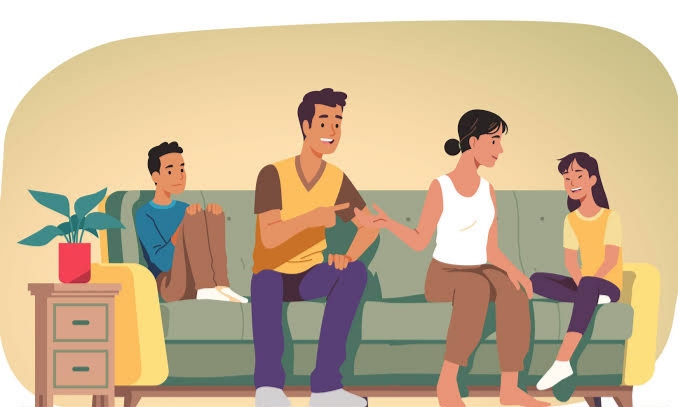
The compound had thin corrugated walls, the kind that carried every sound straight through to the neighbours, and 14-year-old Khadija knew this because she'd once heard Auntie Deeqa next door comment on how loud dinner had been the night before, without realising Khadija was standing right there holding a bucket of water.

Her father, Farah, had a voice that filled a room the second he walked into it, not always in anger, sometimes in laughter, sometimes in storytelling, but often enough in frustration over spilt tea, unfinished chores, or a school report card that wasn't what he'd hoped for.
Her younger brother, Yusuf, who was 10, had developed a habit of going completely still whenever their father's voice rose, and Khadija had spent years assuming that stillness, that flinch, was simply what love from a father was supposed to feel like.
Many households raise their voices, across cultures, across income levels, across generations, and it doesn't automatically mean a child is unloved or a parent is failing.
Farah wasn't a cruel man; he worked long hours at the port, carried worries he rarely spoke about, and had grown up himself in a home where shouting was simply how urgency got communicated.
Understanding this doesn't excuse the impact on children, but it does something important: it separates the volume of a parent's voice from the size of their love, two things that often feel tangled together but are not actually the same measurement at all.
When her mother, Amina, sat beside her while she was peeling potatoes and said, "I know his voice is loud, xaboobo, but it is not a measure of how much he loves you."
That sentence planted something Khadija returned to again and again over the following months.
Here are the honest, practical realisations Khadija built for herself, tested through real evenings of noise and real mornings of quiet apology and lived truths.
A raised voice is often about a parent's stress in that exact moment, not a verdict on a child's worth, and separating those two things takes practice but changes everything about how the sound lands in your chest.
You are allowed to physically step back during a loud moment. Khadija started quietly moving to the room she shared with her cousin whenever voices rose, not as an act of defiance, but as a way of protecting her own calm without needing anyone's permission.
Find your own quiet ritual that belongs entirely to you; for Khadija, it became five minutes of humming her grandmother's old songs under her breath, a small private habit that reminded her body how to settle down after tension.
Talk to the calmer parent when the loud one isn't in the room; Khadija's conversations with her mother in the kitchen became her safest classroom for understanding what was actually happening beneath the shouting, financial pressure, exhaustion, worry about the future, things a raised voice rarely explains clearly in the moment itself.
Notice the apology, even an indirect one, because Farah rarely said "I'm sorry" outright, but he'd bring home Khadija's favourite mango the next day, or ask about her school project with unusual gentleness, and learning to recognise these repair attempts helped her stop waiting for words that culturally weren't going to come easily.
Protect your younger siblings' sense of safety even while managing your own feelings. Khadija began sitting with Yusuf after loud evenings, just sitting close, because children often heal faster simply from not feeling alone in a hard moment.
Understand that a loud household does not automatically predict who you become. Khadija made a conscious decision, one she said out loud to herself in the bathroom mirror more than once, that she would learn to disagree with people calmly, precisely because she knew what growing up around constant volume had felt like from the receiving end.
Build friendships and mentors outside the home who model different emotional tones; her school teacher, Miss Hodan, spoke firmly but never raised her voice, and simply watching that alternative exist, week after week, expanded what Khadija believed was actually possible between people who disagreed.
Keep a private journal of good moments too, not just the hard ones, because Khadija noticed that focusing only on the loud evenings made her forget the mornings her father walked her to school humming old songs, and both memories were true at once.
If the raised voices ever escalate into something that frightens you physically, tell a trusted adult outside the home immediately: a teacher, an aunt, a religious leader, because there is a real and important difference between a loud household and an unsafe one, and no child should carry that distinction alone or in silence.
Practice naming your feelings calmly rather than swallowing them. Khadija started saying, "Aabo, when you shout like that I feel small," and though it took courage the first time, her father's stunned pause told her the message had actually landed somewhere real.
Remember that healing doesn't require your parents to change first, Khadija began managing her own reactions, her own breathing, her own quiet corners of the house, long before her father ever softened his tone, and that self-led calm became hers to keep regardless of what happened around her.


Comments (0)
Please sign in to join the conversation.
Loading comments...