
How to Avoid Fire Accidents at Home
Fire is present in our daily lives and we need it, but if we neglect a tragedy it can happen.
So let’s look at this article tips and hints to have more safety and prevent accidents with fire in our homes.
Basic care
1. Periodically maintain the electrical system. This is important because short circuits are frequent causes of residential fires. Remember to keep the electronic outlet intact.
2. The ideal is to have a well-located light board and circuits identified according to the corresponding points, a specific circuit breaker for the shower, another for lighting the rooms, etc.
3. Gas plumbing is another point that deserves special mention in fire prevention. Safety increases when the tubing, preferably made of copper, is installed in the walls. If the family uses the canister inside the kitchen, make sure that the rubber and gas register are changed every five years. Never use tools to tighten the log butterfly when connecting to the cylinder, as in case of a leak or fire it will be easy to disconnect and stop the leak.
In the absence of energy, families usually light candles in every room of the house. This can result in accidents as they are usually placed in unsuitable places such as wooden furniture, near curtains and flammable objects. The ideal is to keep a flashlight in an easily accessible location, or even have an emergency light that is easily found in the market at affordable prices.
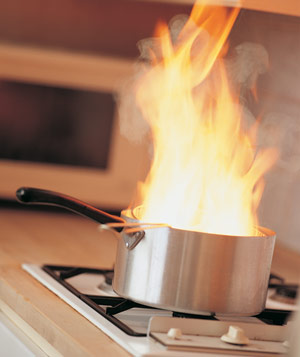
4. The danger when preparing a meal. Who has never seen the mother frying steak and suddenly raising a huge flame over the frying pan? Well, this happens precisely because of the movement that is done. When something that is overheated ignites, you should not move or put under the tap, it will only fuel the fire.
With the movement, more oxygen is brought to the flame, and if you throw water into the flame and the hot liquid will sneeze on all sides, reaching the person, objects and surrounding tissues giving rise to a fire. Ideally, you should smash the flaming vessel with a damp cloth or lid.
5. Never put food to do on the stove or oven and leave the house or if you neglect, go to sleep or watch some program. Many fires start with the burning and overheating of the food, initiating the flame by the high temperature near an object that is flammable.
6. Portable heaters and electric irons can also cause large fires. Whenever you use one of these appliances make sure that the place where you are is not near flammable objects such as curtains, carpets, synthetic or wooden floors, etc. Be sure to unplug from the outlet after use.
7. Ideally, each residence should have a pressurized fire extinguisher for the case of fire in fabric, wood, paper, solids in general and one with carbon dioxide in case of fire in energized materials, conductors of electricity.
Everyone in the family should know how to handle and for what kind of fire each fire extinguisher serves. Some training is essential in these cases, so if there is any kind of accident, everyone knows how to act and evacuate the place.
Do not use trash bins as ashtrays, do not throw cigarette butts out of the window, or leave them on cabinets, tables, and shelves. Avoid accumulation of trash in inappropriate places.
Do not improvise electrical installations or make repairs to outlets and switches without being familiar with it. Do not overload electrical installations with the use of “T plugs” or extensions. Look for a professional with technical knowledge.
Remember: “The motto of well-being is safety first”


